 Image Credit: UniversalImagesGroup / Contributor / Getty
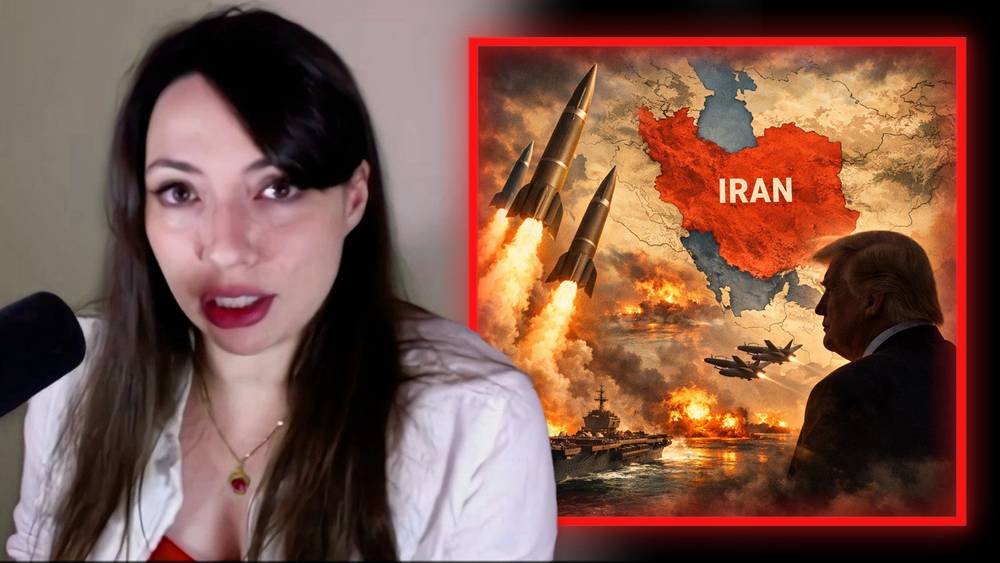
On Wednesday night talkshow host Tucker Carlson reported that Russia is actively considering the use of nuclear weapons against Europe, specifically the UK and Germany.
Tucker’s statement comes from his interview with Sergey Karaganov, one of Russian President Vladimir Putin’s top advisors.
“In that interview he says point blank, yes, if the Ukraine war continues at this tempo for a year or two more, we, speaking apparently on behalf of the Russian government, on behalf of his friend Putin, or at least someone who’s very familiar with President Putin’s thinking, we, Russia, will eliminate the UK and Germany with nuclear weapons,” Tucker said.
Importantly, both the UK and Germany house numerous nuclear reactors. A nuclear detonation near a facility or the results of the electromagnetic pulse can trigger a meltdown, exponentially increasing the radioactive contamination from the attack.
Last week Putin mentioned how the U.S. and Russia both have early warning systems for intercontinental ballistic missiles, but European countries do not.
These early warning systems may be getting used as political rhetoric however, as submarine-launched hypersonic missiles are mere minutes from coastal targets. As missile technology advances, early warning systems have less time to warn before the missiles reach their targets, diminishing their value.
Early warning systems may however reference intelligence operations and surveillance which could perhaps predict a missile launch before it takes place, or even before launch orders are given, in theory.
In this scenario, a defensive action could only be a preemptive attack, which would illicit a response back – a damned if you do, damned if you don’t situation.
Early warning systems carry with them their own risk – false positives. Numerous times over the last half-century early warning systems on both the U.S. and Russian side have reported an incoming attack, which turned out to not be real. If the information was acted upon, the world would be a very different place.
Regardless of early warning capabilities, a defensive action against a single incoming hypersonic missile is hopeful at best. A serious attack however would feature many hypersonic missiles.
Russia updated its nuclear doctrine in November 2024 to allow nuclear responses to non-nuclear attacks.
The updated doctrine outlined the scenarios in which Moscow would be authorized to deploy its nuclear arsenal. These include the ability of Russia to deploy its nuclear arsenal against non-nuclear states which are attacking it with non-nuclear weapons supplied by nuclear states. It also allows Russia to use its nuclear arsenal against nations which are not directly attacking but are aiding the nations which are attacking.
The scenario outlined in the updated doctrine is the exact scenario which the U.S. and NATO states are in, supplying Ukraine with long-range missiles to attack Russia with. The day the doctrine was signed into effect, Ukraine began using U.S./NATO-supplied long-range heavy missiles (capable of carrying a nuclear payload, yet are currently tipped with conventional warheads) to bomb Russia. The doctrine also allows Russia to deploy nuclear weapons against any member state which is in alliance with the aggressor nation, such as all NATO member states and the U.S. in regard to their alliance with Ukraine.
Russia has recently tested a weapon so harmful the U.S. even abandoned it – a nuclear-powered ramjet.
Putin announced that Moscow again tested its nuclear-powered Burevestnik missile, often referred to as a “doomsday” weapon since it would be used to finish off an enemy following a nuclear exchange. The Burevestnik has been in development since 2011 and has been tested numerous times since 2016, often leaving behind radioactive waste and even dead Russian nuclear specialists. Moscow was not the first to develop an “armageddon cruise missile from hell” however, nearly 70-years ago the United States developed its own atomic-powered missile intended to leave no survivors after a nuclear conflict.
In 1957 the United States government launched Project Pluto – a nuclear-powered cruise missile referred to as the Supersonic Low Altitude Missile or SLAM, which used a ramjet engine powered by a small nuclear reactor.
While the American design had an open-loop nuclear ramjet system (the actual air entering and exiting the engine directly contacted the nuclear reactor and thus became highly radioactive), Russia has to this day remained hushed as to if their missile uses an open-loop or a safer closed-loop design which employs a heat exchanger so as to not emit radioactive exhaust gasses.
Regardless of design or even development risks, both the older American and newer Russian nuclear-powered missiles are “doomsday” or “armageddon” weapons – intended to ensure that a nuclear war is not survivable. Their development is likely geopolitical in nature, serving as a nuclear checkmate, ensuring that the notion of a “survivable” nuclear exchange remains out of the military discourse.
In October 2025 President Donald Trump announced the United States will resume nuclear weapons testing. Currently the U.S. is banned from conducting all but underground nuclear weapons testing under the 1963 Limited Nuclear Test Ban Treaty. A 1996 Comprehensive Nuclear Test Ban Treaty would also ban underground testing, although it is not entered into force. China has recently become belligerent on the topic of denuclearization, Trump’s statement came just hours before he was set to meet with the country’s leader Xi Jinping. Soon after, Russia responded by announcing they may also resume nuclear testing.
Trump has repeatedly championed an agenda of global denuclearization numerous times, including after he assumed office for his second term. Trump’s past statements indicate he is likely aware of the true scale of modern nuclear weapons.
Democrat President Harry Truman began to laugh (at 2:30 into the video) as he announced the destructive power he unleashed on civilians, although when he noticed the camera was rolling he appeared shocked as he regained composure.
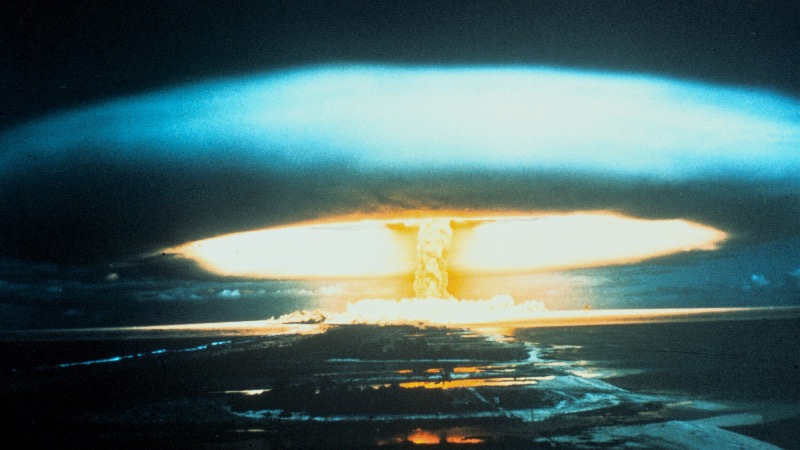
Japan’s atomic experience and the testimony of Western test subjects may serve as a reminder of the true horrors of nuclear war, however the bombs today are thermonuclear, the delivery systems are hypersonic, and the arsenals are far bigger.
In 1945, only an American plane could fly over a target to drop a relatively small device no other country possessed.
Today, numerous countries, chiefly the U.S. and Russia, have the ability to end human life on planet earth. Even third-world nations like India and Pakistan now possess these weapons and, according to Vice News, nuclear bombs can even be purchased on the black market in Bulgaria.
While a nuclear terrorism event would not be world-ending in and of itself, it could fool a nuclear power into believing it is under attack, eliciting a chain of events that results in cataclysmic nuclear extermination.
While nuclear war has been averted since the inception of the weapon, there is no guarantee that atomic peace will last forever. Mathematically at least, the longer humanity has lived with the bomb, the greater the chance it will have been used.