 Image Credit: NurPhoto / Contributor / Getty
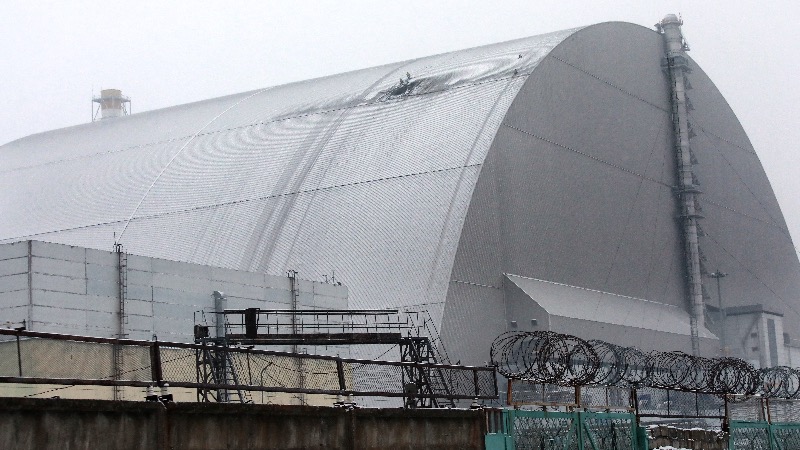
In February a drone bombed the Chernobyl nuclear reactor in Ukraine, damaging the roof of the New Safe Confinement (NSC) structure that was placed over the radioactive facility which suffered a complete meltdown and explosion in 1986. While no radiation was released after February’s drone bombing, it was reported Wednesday that the $2 billion protective shield had cracked as a result of the bombing, triggering fears of radiological emissions.
Note that both Ukraine and Russia have blamed the other for the drone attack. While serious repairs may need to wait for the Ukraine war to be over, the country’s Dictator Vladimir Zelensky has signaled that his war will continue into 2026 and that President Donald Trump who is seeking to end the war may die.
The premier nuclear watchdog group, the International Atomic Energy Agency (IAEA) conducted a safety inspection earlier December where they discovered this protective dome had lost its primary safety functions, including confinement capability, although its main structure and monitoring systems remain intact.
Embed from Getty ImagesRescuers work at the site where a Russian attack drone with an explosive warhead hits the New Safe Confinement at the Chornobyl Nuclear Power Plant in the Kyiv region, Ukraine, on January 14, 2025. The structure, put in place in 2016, protects the remains of Reactor 4 destroyed during the 1986 Chornobyl disaster. (Photo by Volodymyr Tarasov/Ukrinform/NurPhoto via Getty Images)
“Limited temporary repairs have been carried out on the roof, but timely and comprehensive restoration remains essential to prevent further degradation and ensure long-term nuclear safety,” IAEA director general Rafael Mariano Grossi said in the statement.
“The IAEA – which has a team permanently at the site – will continue to do everything it can to support efforts to fully restore nuclear safety and security at the Chornobyl site,” Grossi said.
The watchdog organization called for urgent repairs and upgrades to the NSC, including better humidity control, advanced corrosion monitoring and a high-tech automatic system to keep the nuclear reactor remains under control.
“In 2026, with support from the European Bank for Reconstruction and Development (EBRD), the Chornobyl site will undertake additional temporary repairs to support the re-establishment of the NSC’s confinement function, paving the way for full restoration once the conflict ends,” the Daily Mail said.
Chernobyl plant workers must keep humidity within a small range within the new containment unit to avoid radioactive releases. Too little and radioactive dust forms, too much and radioactive water forms. A hole in the roof would greatly affect internal humidity.
The original containment building (the one erected over the exploded reactor building directly following the incident) was constructed quickly and has been showing signs of structural fatigue. This is why the new containment unit was erected over it in the 2010s.
If the old unit collapses then immense amounts of radioactive dust will form, and worse, nuclear fuel still within the reactor unit may begin to fissile and undergo reactions, leading to huge releases of radiation and potential nuclear fire due to the massive heat release – another meltdown.
In December 2024 a drone bombed a vehicle carrying international nuclear reactor inspectors in Ukraine, which Kiev and Moscow blamed each other for as well.
MUST-WATCH ALEX JONES & NICK FUENTES INTERVIEW / DEBATE — 12/17/25