 Image Credit: CHRIS J RATCLIFFE / Contributor / Getty
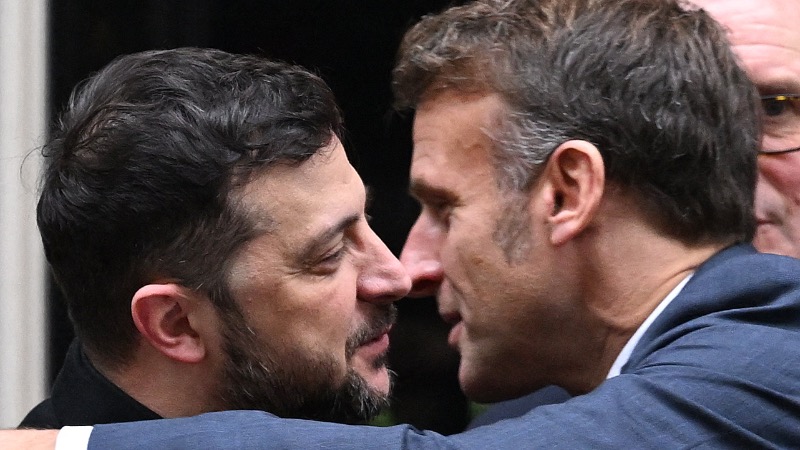
On Tuesday French President Emmanuel Macron announced that Ukraine’s European backers are preparing to resume dialogue with Russian President Vladimir Putin. Italian Prime Minister Giorgia Meloni and German Chancellor Friedrich Merz have also expressed interest in speaking to the Kremlin. This shift is noteworthy as Ukraine’s European enablers have been the driving force behind the continuation of the war.
According to Macron, the reasoning behind this decision is to reestablish a channel of communication independent from the U.S.
“It is important that Europeans restore their own channels of discussion,” Macron said Tuesday. “This is being prepared and discussions are taking place at a technical level.”
The French President said that this line of communication is being made “transparently” with Ukraine’s Dictator Vladimir Zelensky. While Macron reaffirmed France’s support of Ukraine, he discussed how a resumption of contact with Moscow is necessary to negotiate security guarantees after the war.
“I think it would be useful, but I don’t think Russia is currently willing to conclude a peace agreement in the coming days or weeks,” he said. “We continue to support Ukraine, which is under bombardment, in the cold, with attacks on civilians and on Ukraine’s energy infrastructure by the Russians, which is intolerable and does not demonstrate a genuine willingness to negotiate for peace.”
Dialogue between Western European leaders and the Kremlin generally ceased following the outset of Russia’s Special Military Operation against Ukraine in February 2022.
In July 2025 Macron held a rare phone call with Putin in which the two discussed the conflict between Iran and Israel, as well as touched on the Ukraine conflict which is much closer to home for them. While they still held disagreements over the Ukraine war, both showed an inclination toward a peaceful end to the hostilities. Previous to this, the two spoke in September 2022, months after the Ukraine war began.
On Sunday French Foreign Minister Jean-Noel Barrot said that the European Union must establish its own direct communication line with Russia, sidestepping the U.S. as a middleman.
“The Europeans, who are now Ukraine’s main financial and military backers, must have a channel to assert their interests, without delegating responsibility to anyone else,” Barrot said.
“These comments reflect mounting anxiety within EU capitals that their geopolitical clout is eroding as U.S. President Donald Trump has spent recent months pursuing bilateral negotiations with both Kiev and Moscow to end the Ukraine war. French President Emmanuel Macron and Italian Prime Minister Giorgia Meloni have pushed for the EU to designate a special representative to Russia, ensuring the bloc secures its place in any settlement discussions,” media outlet MENAFN said Monday.
In December 2025 Macron urged the EU to “reengage” with Moscow.
“It is welcome that the Kremlin has publicly agreed to this approach. We will decide in the coming days on the best way to proceed,” Macron said in December.
Then in January Italian Prime Minister Giorgia Meloni publicly agreed with Macron during her start-of-year press conference in Rome.
“I think Macron is right about this. I believe that the time has come for Europe to talk to Russia too,” she said.
The following week German Chancellor Friedrich Merz said that the EU would benefit if it could find common ground with Moscow.
“If we succeed, in the longer perspective, in finding a balance again with Russia, if there is peace… then we can look ahead with great confidence beyond the year 2026,” he said.
Soon thereafter Kremlin spokesman Dmitry Peskov said that Moscow welcomes the “positive shift” in European sentiment toward dialogue, and “surprising as it may seem,” the views expressed in the European’s statements are “entirely consistent” with Moscow’s perspective.
“[If such remarks] truly reflect the strategic vision of the Europeans, then it represents a positive evolution in their position,” Peskov said in January following the statements from Macron, Meloni and Merz.
“One would like to believe that, over time, the situation will nonetheless change and our states will return to normal, constructive dialogue,” Peskov said, but emphasized that respect for Russia’s national interests and consideration of legitimate security concerns must be met.
EU foreign policy chief Kaja Kallas rejected the quest for dialogue however, saying that Brussels has nothing to offer Moscow in talks.
”We can’t… go to Russia and say ‘talk to us,’” she said on January 30. “The concessions that the Americans are putting on Ukraine are quite strong, so I don’t think there’s anything we can offer to Russia on top of that. Why should they talk to us?”
Washington is continuing its dialogue with Moscow. The U.S. is set to hold a trilateral peace negotiation with officials from Ukraine and Russia in Abu Dhabi, United Arab Emirates on Wednesday and Thursday.
Alex Jones Exposed Epstein’s Cloning Facility In 2019