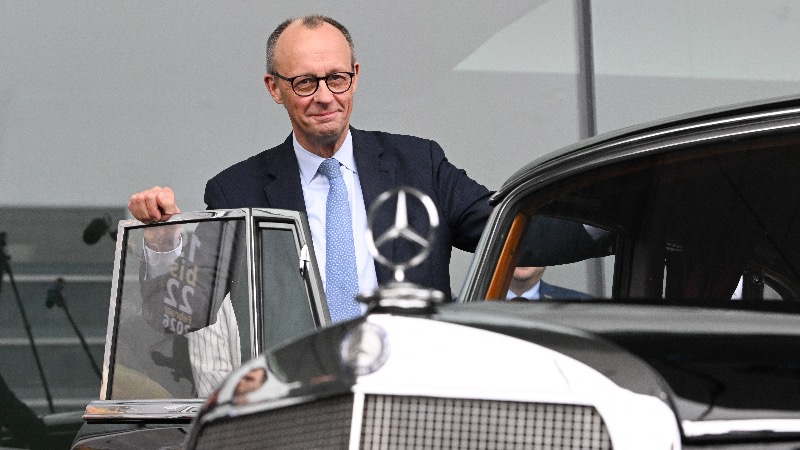
 Image Credit: THOMAS KIENZLE / Contributor / Getty
German Chancellor Friedrich Merz wants to end online anonymity.
Speaking Wednesday evening at an event held by his conservative Christian Democrats in Trier, he called for mandatory real names across social media and floated a potential ban on platforms for users under 16.
“I want to see real names on the internet. I want to know who is speaking,” Merz said.
The framing is the same as usual; protect democracy, protect children. What Merz left out is worth examining closely.
Germany’s criminal code is already a problem. Sections 185 through 187 criminalize insults, malicious gossip, and defamation against ordinary citizens. Those carry fines or prison sentences capped at two years for insults and malicious gossip, five years for defamation.
Section 188 covers the same offenses when directed at politicians. The penalties are steeper across the board: three years maximum for insults, mandatory prison time with a five-year ceiling for malicious gossip (minimum three months), mandatory prison time with a six-month floor and five-year ceiling for defamation. No fine option.
Politicians use these laws. Merz uses these laws. He has filed hundreds of complaints himself. CDU politicians and others flag thousands of posts to prosecutors annually, and German police conduct hundreds of raids each year for insults and alleged “hate speech.” The infrastructure for going after ordinary citizens who criticize their representatives already exists and is already in active use.
What a real name mandate does is remove the last barrier between a critical post and a knock on the door. Right now, authorities have to work to identify anonymous speakers. With real names required by platform policy, that step disappears.
Merz framed his position as symmetry. “In politics, we engage in debates in our society using our real names and without visors. I expect the same from everyone else who critically examines our country and our society.”
But politicians operate with institutional resources, legal teams, and parliamentary protections. A citizen posting a pointed criticism of a public official from their personal account has none of that. They do have something, for now: the option to do it without their name attached. Merz wants to take that away.
He also criticized those who defend anonymity, saying they are “often people who, from the shadows of anonymity, demand the greatest possible transparency from others.” The characterization treats pseudonymous speech as inherently suspicious, which is one way to frame it. Another is that people have historically needed cover to say true things about powerful people without facing retaliation.
Merz warned that “enemies of our freedom, enemies of our democracy, enemies of an open and liberal society” were using algorithms and AI to run targeted influence campaigns, and that he had underestimated how effectively these tools could manipulate public opinion.
Merz asked: “Do we want to allow our society to be undermined in this way from within and our youth and children to be endangered in this way?”
It’s a pointed question. A more uncomfortable one: do we want to hand politicians whose parties already file mass complaints under insult laws a system that automatically links every critical post to a verified identity?
THE GREAT AWAKENING ACCELERATES!!!