 Image Credit: Allan Wall
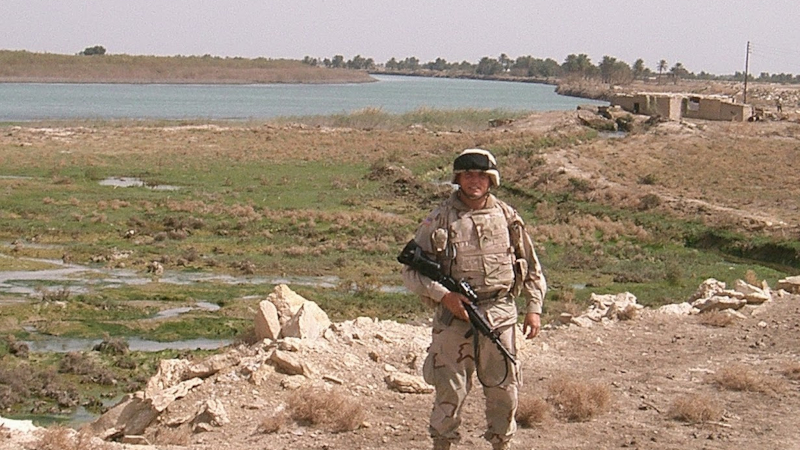
Twenty years ago, Uncle Sam sent me on an all expenses paid trip to Iraq, where I served a tour of duty as part of the Texas Army National Guard.
Reflecting on my experience and observations in Iraq, I see lessons we can learn about the multiculturalism and immigration we deal with today.
In 2005, the size and scope of the American presence in Iraq was enormous.
The U.S. was operating a vast complex of over 100 military bases, served by fleets of supply trucks and manned by hosts of military and civilian personnel.
Bases were constantly being upgraded in continuous construction projects.
One of several tasks I performed in Iraq was working on a fence-building project with local Iraqis. (I wonder whatever happened to those guys?)
Together, we constructed a sturdy barrier designed to impede unauthorized entry to a U.S. base. I have to say, it looked like a pretty good fence.
Certainly, just building a fence is not enough. You need personnel guarding it as well.
But if the U.S. government could spend such time and money building up such an infrastructure halfway around the world, why couldn’t the same effort be made to secure our own border?
While in Iraq, I submitted an article on this topic to National Review Online and it was published with the title, “To The Borders!”
“Some say it’s impossible to secure our borders. I don’t believe it. Here in Iraq I’ve seen what a determined national policy can accomplish in a short time. Back home, borders could be secured, if the political will existed,” I wrote in the piece.
Twenty years later my wish was granted, as the Trump II administration, despite the many naysayers, rapidly achieved control of our border. All along it was a question of will, not capability.
At the beginning of the Iraqi occupation, there was much optimism about the future of Iraq, based on the successful occupations of Germany and Japan after World War II.
Didn’t our post-war reconstruction efforts rebuild our former enemies Germany and Japan into thriving democracies and allies?
Here was an opportunity to do the same in the Middle East.
But it didn’t work out as planned.
After dictator Saddam Hussein was overthrown, new waves of violence broke out.
Besides insurgency against the U.S. occupation, there was conflict between rival Iraqi groups.
Had the architects of the occupation not given serious thought as to what sort of country Iraq is?
Although Iraq is an ancient land, as a nation-state it only dates back to the 20th century, when it was cobbled together from provinces of the disassembled Ottoman Empire.
Iraq is a mosaic of competing tribes, factions and religious sects. Diversity, in other words.
The two principal Islamic sects, Sunni and Shia, were at each others’ throats.
In one U.S.-run detention camp, Sunni and Shiite detainees fought each other over how to celebrate Ramadan, their common Islamic holiday.
Indeed, not even everybody within the same sect of Islam always gets along.
One night in 2005, a bitter battle broke out between two Shiite militias. They went at it hammer and tongs. I called it the “Shiite Shootout” and we stayed out of it.
Then there are the Kurds in the north, some of whom don’t even want to be part of Iraq.
Add to that the existence of many local tribes and factions. Non-Muslim religious minorities include Christians, Yazidis and Mandaeans.
American foreign policy architects have a big problem dealing with the nature of Islam, an ideology with a definite political orientation at odds with Western Civilization. We’re just not supposed to talk about that.
In fact, U.S. Middle Eastern policy has promoted Islam, which President George W. Bush called “a religion of peace,” turning a blind eye to Muslim persecution of religious minorities.
These are all the sorts of things occupational powers inevitably have to deal with once they get into nation building, especially in a region radically different from our own.
So how do we avoid such problems in the future?
One solution is to reserve our nation-building efforts for the American nation.