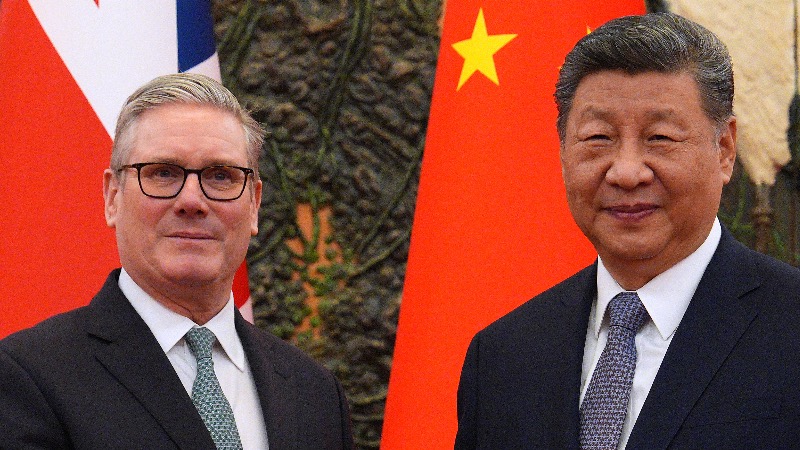
 Image Credit: Carl Court / Staff / Getty
British Prime Minister Keir Starmer landed in Beijing on January 28th to begin a four-day official visit that breaks with years of diplomatic cooling between London and China.
The trip, the first by a British head of government since 2018, takes place in an increasingly polarised international context, with relations between China and the United States marked by strategic distrust, technological rivalry, and a gradual economic decoupling.
Starmer’s agenda includes meetings with Chinese President Xi Jinping and Prime Minister Li Qiang, as well as a stop in Shanghai. The Labour government aims to signal that the United Kingdom wants to redefine its relationship with Beijing through a ‘pragmatic’ approach, focused on the national interest, attracting investment, and strengthening trade ties with the world’s second-largest economy.
In remarks to the media, Starmer argued that engaging with China “is in the national interest” of the United Kingdom and warned that ignoring Beijing “would not be sensible.” At the same time, he stressed that London will not be forced to choose between China and the United States and that his government will maintain “close ties” with Washington on security and defence.
That delicate balancing act neatly sums up the position of several European governments, which, without breaking with their Atlantic ally, are seeking room for manoeuvre in the face of a White House that is becoming increasingly confrontational towards China.
The British visit is not an isolated case. In recent months, other European leaders have stepped up contacts with Beijing to protect commercial interests, secure supply chains, and avoid being trapped in a bloc-based logic. For Europe, highly dependent on foreign trade and hit by a loss of industrial competitiveness, China remains an economic partner that is difficult to replace.
Starmer is accompanied by members of his cabinet and a delegation of around 60 business leaders, including representatives from HSBC, GSK, Jaguar, and Land Rover. According to Downing Street, the aim is to “strengthen trade ties” and expand economic cooperation. From Beijing, the signing of agreements was announced in areas such as clean energy, health, creative industry, and smart manufacturing, as well as the holding of a bilateral business forum.
The data illustrate the scale of the relationship: in 2025, trade in goods between the two countries reached $103 billion, while services exchanges were around $30 billion, and bilateral investment stood at roughly $68 billion. These figures help explain why, beyond ideological rhetoric, London—like other European capitals—opts for economic realism.
Nevertheless, the rapprochement is not without domestic controversy. The recent authorisation to open a Chinese ‘mega-embassy’ in London has sparked criticism over potential risks to national security, amid growing concern about foreign influence and technological espionage.
From China’s Ministry of Foreign Affairs, spokesman Guo Jiakun described the visit as an opportunity to “strengthen mutual political trust” and contribute to “global stability.” The language contrasts with Washington’s increasingly hardline tone towards Beijing and highlights Europe’s discomfort in the face of an escalation that threatens to harm its own interests.
For Starmer’s United Kingdom—and for much of Europe—the underlying question is whether there is still space for a sovereign foreign policy, based on national interest, and not automatically subordinated to ideological agendas or external conflicts. The visit to Beijing suggests that, at least on the economic front, some European leaders are beginning to answer in the affirmative.
BREAKING: TRUMP STRIKES BACK!!!