 Image Credit: NurPhoto / Contributor / Getty
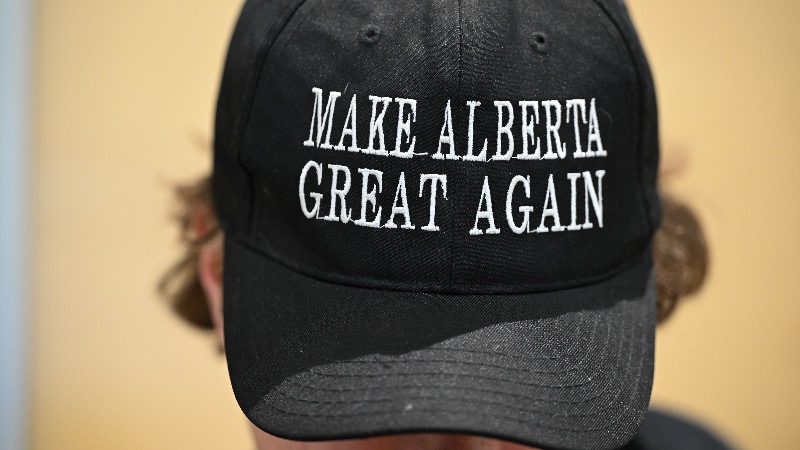
On Thursday a report from The Financial Times claimed that White House officials held secret meetings with Albertan separatists who are looking to secede from Canada. Allegedly, the separatists are seeking hundreds of billions of dollars from Washington (as credit), should they win a referendum to leave Canada. The U.S. appears to see Albertan independence as advantageous to Trump’s America First agenda, perhaps even advancing the goals laid out in the White House’s National Security Strategy.
“Leaders of the Alberta Prosperity Project, a group of far-right separatists who want the western province to become independent, met U.S. state department officials in Washington three times since April last year, according to people familiar with the talks,” The Financial Times has claimed. “They are seeking another meeting next month with state and Treasury officials to ask for a $500bn credit facility to help bankroll the province if an independence referendum — yet to be called — is passed.”
Jeff Rath, legal counsel to the Alberta Prosperity Project (APP) attended these meetings and spoke to The Financial Times. He said that the Albertan separatist movement is held in high regard by U.S. officials.
“The U.S. is extremely enthusiastic about a free and independent Alberta,” Rath said, also telling the news website that he has a “much stronger relationship” with the Trump administration than Canadian Prime Minister Mark Carney.
With a new governing body potentially forming in North America, U.S. officials would be expected to hold dialogue with these leaders from a very early stage, including behind closed doors.
“The [State] Department regularly meets with civil society types. As is typical in routine meetings such as these, no commitments were made,” a State Department spokesperson said.
A source at the White House appears to have loosely confirmed these Albertan/American meetings to The Financial Times.
“Administration officials meet with a number of civil society groups. No such support, or any other commitments, was conveyed,” a White House official said.
While the U.S. Treasury declined comment to The Financial Times, “A person familiar with Treasury secretary Scott Bessent’s thinking said neither he nor any other Treasury officials were aware of any credit facility proposal and did not intend to engage on the issue. The person added that no senior Treasury department official had received a request for a meeting.”
Recently, Treasury Secretary Scott Bessent described Alberta as a “natural partner” for the U.S. while speaking about their oil pipeline aspirations, which are currently being blocked by Canada.
Social media accounts promoting Albertan separation from Canada often discuss the economic situation, where Alberta effectively bankrolls the Canadian capital Ottawa, despite the two peoples holding very different cultural values.
Interestingly, the report by The Financial Times comes after President Donald Trump repudiated the New World Order at Davos – the same globalist system Carney himself spoke out in defense of earlier this month.
On January 15 Carney told the world that his New World Order is a joint Canada / Communist China / Eurocrat global government.
“Mine is the first visit of a Canadian Prime Minister to China in nearly a decade. The world has changed much since that last visit,” Carney told Communist Chinese Party leaders, including President Xi Jinping. “And I believe the progress that we have made and the partnership sets us up well for the New World Order.”
When asked about what he meant when he declared a New World Order, Carney replied:
Well, it’s a great question, Brian, because I think the world is still determining what that order is going to be.
And let’s be clear what we’re talking about first and foremost, which is: what are the trading…What is going to govern global trade? What is the role of the WTO going to be? How important are bilateral deals, such as the one we’re developing, plural lateral deals, if I can use that term, Trans-Pacific Partnership, potential linkages between Trans-Pacific Partnership and the EU. Where is financial regulation, payment system regulation going to fit into that?
All of these aspects — I’m gonna use fancy words — like the architecture, the multilateral system that has been developing these, is being eroded, to use a polite term, undercut, to use another term.
So the question is, what gets built in that place? How much of a patchwork is it? How much is it just on a bilateral basis, or where do like-minded countries, in certain areas – so like-minded countries, just to be clear, doesn’t mean you agree on everything. So aspects, for example, on digital trade or agricultural trade, climate finance as another area. To move into areas of geo-strategy, geo-security, you will have different coalitions that are formed.
So what this partnership does is, in areas, for example, of clean energy, conventional energy, agriculture as we were just talking about, and financial services — which we’ve talked less about — but the evolution of the global financial system, the role of the renminbi over time, the evolution of cross-border payments.
I know it all sounds very dry, except for your organization, which I think takes an interest in it. These are important elements of how the system is going to work. And look, the expectation is that rather than these being developed necessarily through the IMF, WTO, and other multilateral organizations, it is going to be coalitions that develop them — not for the world, but for sub-sectors of the world.
Carney’s relationship with China was short-lived however, as Trump put a stop to it using Washington’s financial prowess.
“Canadian Prime Minister Mark Carney says Canada has ‘no intention’ of pursuing a free trade deal with China, after Donald Trump threatened to slap a 100% tariff on Canadian exports if Ottawa ‘makes a deal’ with Beijing,” ZeroHedge said Monday.
The aforementioned waffling by Carney indicates a Canadian geopolitical defeat at the hands of Trump’s international policy agenda.
In line with his reinstatement of geopolitical policies analogous to the Monroe Doctrine, Trump launched the attempt to prohibit the communist Chinese from further entrenching themselves in Canada. The move comes as the President codified his “Donroe Doctrine” of American foreign policy.
Trump addressed the Canadian Prime Minister, who he referred to as “governor” due to the Commonwealth’s natural and intrinsic subordination to the American superpower:
If Governor Carney thinks he is going to make Canada a “Drop Off Port” for China to send goods and products into the United States, he is sorely mistaken. China will eat Canada alive, completely devour it, including the destruction of their businesses, social fabric, and general way of life. If Canada makes a deal with China, it will immediately be hit with a 100% Tariff against all Canadian goods and products coming into the U.S.A. Thank you for your attention to this matter!
President DJT
While the White House’s National Security Strategy only mentioned Canada once as part of an economic policy to restrain China, the significance of Carneys attempted CCP relationship comes into full view.
The National Security Strategy document said on page 22:
America First diplomacy seeks to rebalance global trade relationships. We have made clear to our allies that America’s current account deficit is unsustainable. We must encourage Europe, Japan, Korea, Australia, Canada, Mexico, and other prominent nations in adopting trade policies that help rebalance China’s economy toward household consumption, because Southeast Asia, Latin America, and the Middle East cannot alone absorb China’s enormous excess capacity. The exporting nations of Europe and Asia can also look to middle-income countries as a limited but growing market for their exports.
With President Trump battling a New World Order that’s using Canada as a geopolitical weapon, weakening that structure by removing its most valuable province (Alberta) would throw a wrench into the cogs of globalism.
Importantly, while Canada is able to exercise self-rule over its citizens and to an extent make international deals, the British sovereign, currently King Charles III, holds dominion over the Commonwealth. His Majesty’s Governor General can be directed to dissolve Canadian Parliament should the overseas British possession stray too far from alignment with the will of the King.
Alberta may currently be dealing with Ottawa, but if its will of independence proceeds much further it may find itself at loggerheads with London and the patriarch of the Windsor (formally the Saxe-Coburg and Gotha) family.
The Crown’s True Dominion: Shadow Power