 Image Credit: SAUL LOEB / Contributor / Getty
President Donald Trump set a 10-day deadline for Iran to agree to a new nuclear deal. The President’s proclamation comes after his Special Envoy Steve Witkoff held talks with Tehran in Geneva, Switzerland on Tuesday, after which an unnamed U.S. source reported that the Iranians will submit proposals for such a deal within two weeks.
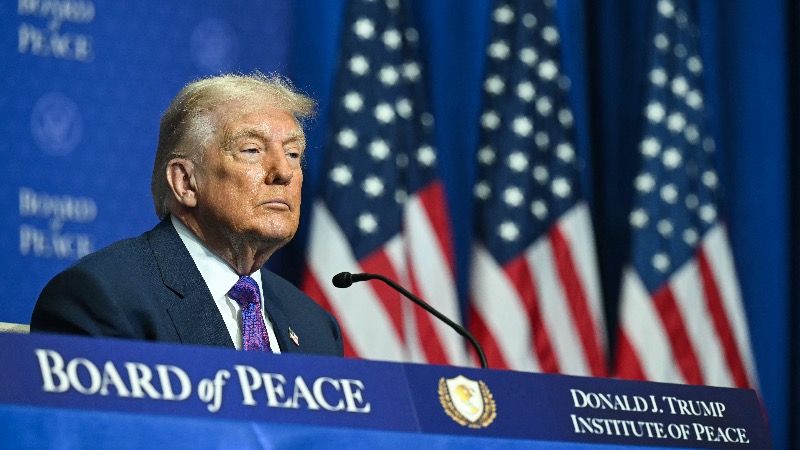
“So now we may have to take it a step further, or we may not,” Trump said Thursday while speaking at the first meeting of his new Board of Peace working group. “Maybe we’re going to make a deal. You’re going to be finding out over the next probably 10 days.”
Watch Trump’s statements at the first Board of Peace meeting here:
Trump has remained optimistic on reaching a nuclear deal with Iran over the last year. With that being said, the President is keeping all options open, which was confirmed by Vice President JD Vance on Tuesday, following the Geneva meeting.
Trump was unhappy with the 2015 Iran nuclear deal and withdrew from it during his first term in office. He has since been seeking to enact a new agreement.
“It’s proven to be, over the years, not easy to make a meaningful deal with Iran. We have to make a meaningful deal. Otherwise bad things happen,” Trump said Thursday, with the “bad things” referring to the military option.
Notably, this 2015 ‘Iran nuclear deal’ involved then-President Barack Obama shipping $400 million in cash on pallets to Tehran in exchange for the promise they will refrain from developing nuclear weapons.
While no deal was reached between officials from Washington and Tehran on Tuesday, Reuters reported that an unnamed U.S. official said Iran would make detailed proposals in the next two weeks to close gaps in the nuclear talks.
“Progress was made, but there are still a lot of details to discuss,” the U.S. official said Tuesday. “The Iranians said they would come back in the next two weeks with detailed proposals to address some of the open gaps in our positions.”
Tehran’s official at Tuesday’s meeting, Foreign Minister Abbas Araqchi, said that the two sides reached an understanding on the main “guiding principles” of nuclear deal negotiations.
Iran’s President, who also took part in the Geneva negotiations, voiced interest in a diplomatic resolution.
Following the conclusion of the meeting Tuesday, Iranian President Masoud Pezeshkian announced that Tehran is willing to allow outside nations to confirm that they are not developing nuclear weapons.
“We are absolutely not seeking nuclear weapons,” Pezeshkian said. “If anyone wants to verify this, we are open to such verification to take place.”
Pezeshkian went on to affirm the Iranian interest in non-weaponized nuclear technology, something Israeli Prime Minister Benjamin Netanyahu is completely opposed to. On Sunday Netanyahu said “The first is that all enriched material has to leave Iran … There should be no enrichment capability – not stopping the enrichment process, but dismantling the equipment and the infrastructure that allows [them] to enrich.”
“However, we do not accept that we should be prevented from using [nuclear] science and knowledge to address our illnesses and to advance our industry and agriculture,” Pezeshkian said.
The Dictator of Iran, Ali Khamenei, took a much more belligerent tone. The Dictator went so far as to threaten the U.S. on Tuesday, although the irate posts on his social media seem to have ceased following his barrage of harsh language Tuesday.
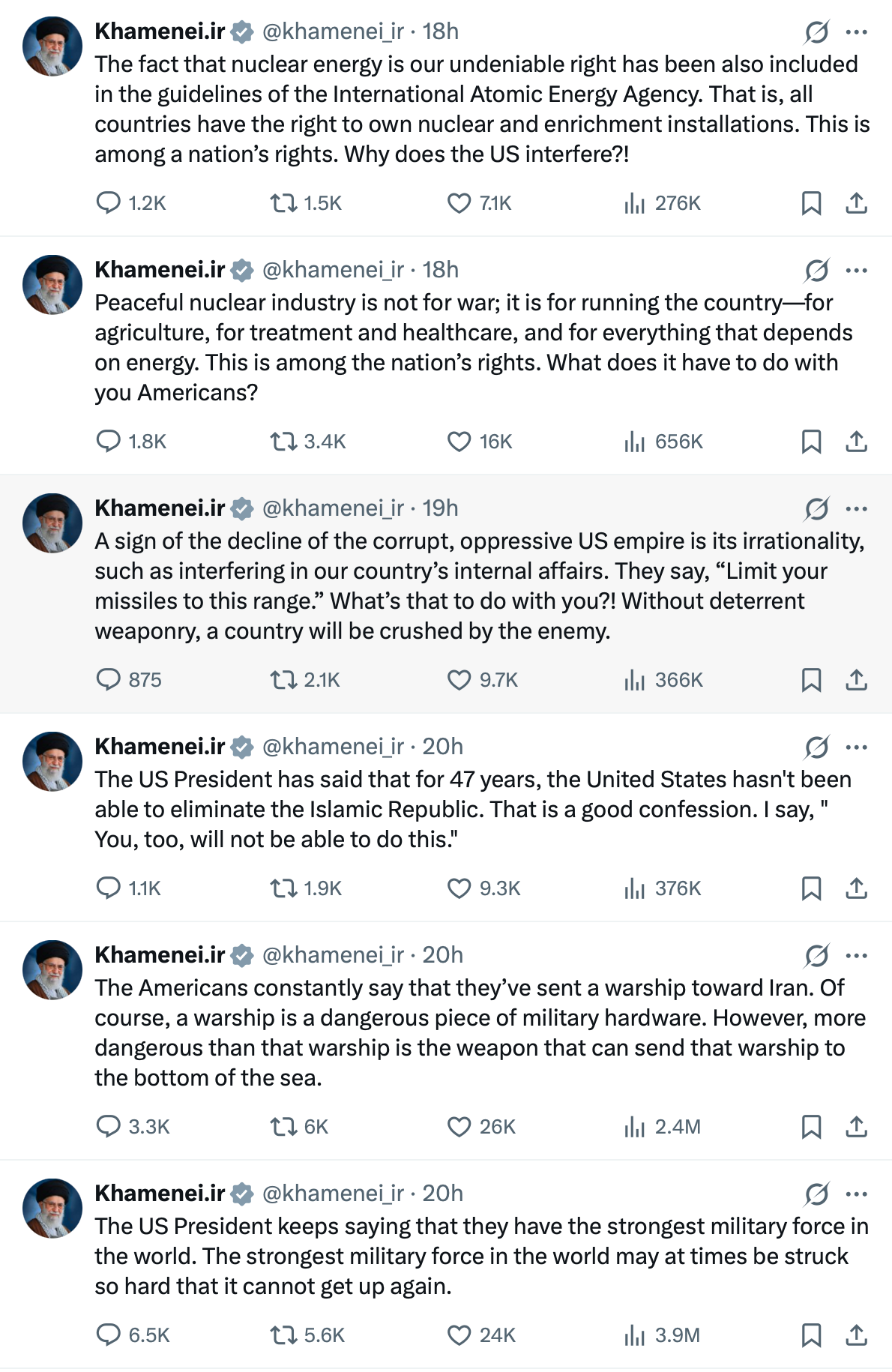
Media organization News Of The United Stated (NOTUS) detailed the intensifying military activity surrounding Iran as tensions heat up between the Trump administration and the Islamic republic:
Trump argued that the Middle East cannot be stable if Iran can build a nuclear weapon.
“Now is the time for Iran to join us on a path that will complete what we’re doing,” Trump said. “And if they join us, that will be great. If they don’t join us, that will be great too, but it will be a very different path.”
“They cannot continue to threaten the stability of the entire region, and they must make a deal,” he added. “Or if that doesn’t happen … bad things will happen if it doesn’t.”
The U.S. is tightening the pressure on Tehran. A second aircraft carrier is heading toward the Middle East to join another already in the region, part of a broader naval and air buildup as the administration keeps military options in play if diplomacy fails. Indirect talks in Geneva on Tuesday produced some early areas of understanding, but negotiators said major issues remain unresolved and more proposals are expected.
Iran has answered with its own signals. Tehran has carried out missile drills and naval exercises and warned it would retaliate if attacked. Supreme Leader Ayatollah Ali Khamenei has also cautioned that any U.S. attempt to strike or destabilize Iran would trigger a response.
THE GREAT AWAKENING ACCELERATES!!!