 Image Credit: - / Contributor / Getty
On Tuesday representatives from the U.S. and Iran are set to hold negotiations over the future of the Iranian nuclear program in Geneva, Switzerland. President Donald Trump’s agenda seeks to prevent Iran from developing nuclear weapons, although Tehran claims their interest solely resides in nuclear energy technology. Trump famously blew up what was said to be Iranian nuclear sites in June, although the Islamic nation is reportedly seeking to continue nuclear development.
“I am in Geneva with real ideas to achieve a fair and equitable deal. What is not on the table: submission before threats,” Iranian Foreign Minister Abbas Araghchi said Monday.
The team from Washington is set to mediate talks between Russia and Ukraine following the Iranian negotiations.
“A U.S. delegation including envoys Steve Witkoff and Jared Kushner will meet with the Iranians on Tuesday morning, the source said. Representatives from Oman will be on hand and mediate the U.S.-Iran contacts, the source said,” according to Reuters.
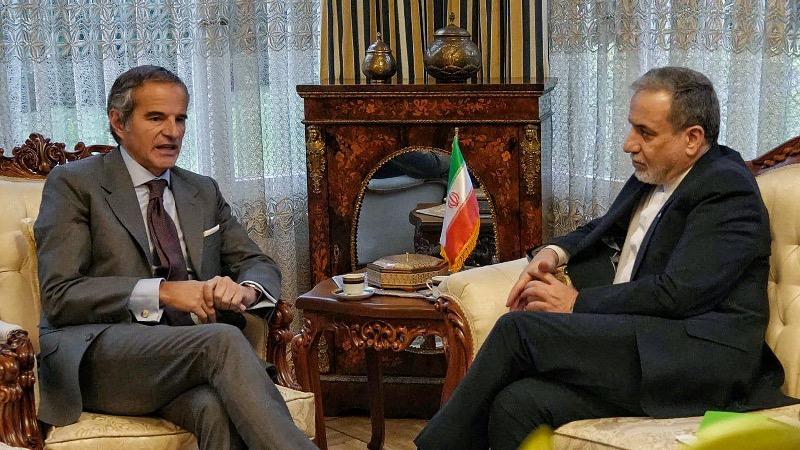
Ahead of Tuesday’s meeting with the representatives from Washington, Araghchi met with International Atomic Energy Agency (IAEA) Director General Rafael Mariano Grossi on Monday.
Embed from Getty ImagesImage credit: GENEVA, SWITZERLAND – FEBRUARY 16: (—-EDITORIAL USE ONLY – MANDATORY CREDIT – ‘RAFAEL MARIANO GROSSI’S X ACCOUNT / HANDOUT’ – NO MARKETING NO ADVERTISING CAMPAIGNS – DISTRIBUTED AS A SERVICE TO CLIENTS—-) Iranian Foreign Minister Abbas Araghchi (C) meets with International Atomic Energy Agency (IAEA) Director General Rafael Mariano Grossi (L) in Geneva ahead of nuclear talks with the United States, on February 16, 2026. (Photo by Rafael Mariano Grossi’s X Account/Anadolu via Getty Images)
Israel’s Prime Minister Benjamin Netanyahu insisted that Tehran be barred from enriching uranium at all costs, but also said that he was “skeptical” a deal could be reached. The Israeli leader laid out key elements he believes are necessary for such a deal while speaking at the Conference of Presidents of Major American Jewish Organizations on Sunday.
“The first is that all enriched material has to leave Iran,” he said. “There should be no enrichment capability – not stopping the enrichment process, but dismantling the equipment and the infrastructure that allows [them] to enrich.”
Despite Netanyahu’s meeting with Trump on Wednesday, the White House remained focused on diplomacy through negotiations.
“There was nothing definitive reached other than I insisted that negotiations with Iran continue to see whether or not a Deal can be consummated,” Trump said following the meeting.
Notably, Trump is still keeping the military option within arms reach. In January he sent a carrier strike group to Iran.
Trump said “maybe we won’t have to use” the carrier strike group, but that the U.S. had “a lot of ships” on the way “just in case.”
The President has not held back rhetoric toward the Islamic dictatorship, in January he directly threatened to blow up the entire country if they assassinated him.
“They shouldn’t do it, but I’ve left notification. Anything ever happens, the whole country is going to get blown up… I would absolutely hit them so hard. But I have very firm instructions. Anything happens, they’re gonna wipe them off the face of this earth,” Trump said, despite it opening the door to Iran’s enemies [Israel] attempting an assassination to have their arch nemesis destroyed.
Adding tension to Tuesday’s talks, Iran began military exercises in the Strait of Hormuz Monday.
Embed from Getty ImagesImage credit: IRAN – FEBRUARY 16: (—-EDITORIAL USE ONLY – MANDATORY CREDIT – âPRESS OFFICE OF THE ISLAMIC REVOLUTIONARY GUARD CORPS / HANDOUT’ – NO MARKETING NO ADVERTISING CAMPAIGNS – DISTRIBUTED AS A SERVICE TO CLIENTS—-) Iranian military personnel take part in an exercise titled ‘Smart Control of the Strait of Hormuz’, launched by the Naval Forces of the Islamic Revolutionary Guard Corps, is being carried out in the Persian Gulf and the Strait of Hormuz on February 16, 2026. (Photo by Press Office of Islamic Revolutionary Guard Corps / Handout/Anadolu via Getty Images)
Iran reportedly hopes to make a deal with the U.S., as such they seek joint industrial and economic ventures be incorporated into a nuclear deal.
“For the sake of an agreement’s durability, it is essential that the U.S. also benefits in areas with high and quick economic returns,” Iranian foreign ministry deputy director for economic diplomacy Hamid Ghanbari said Sunday. “Common interests in the oil and gas fields, joint fields, mining investments, and even aircraft purchases are included in the negotiations.”
Regarding the question of the nuclear program itself, on Sunday Iranian deputy foreign minister Majid Takht-Ravanchi offered to dilute its stockpile of uranium enriched to 60% purity as evidence of its willingness to compromise – lower enrichment uranium fit for nuclear energy, but not nuclear weapons.
The BBC elaborated on the Iranian attempt at atomic compromise:
At near weapons-grade level, it has deepened suspicion that the Islamic Republic is moving towards the development of a nuclear weapon, something it has always denied.
“We are ready to discuss this and other issues related to our programme if they are ready to talk about sanctions,” Takht-Ravanchi told the BBC. He would not confirm whether this meant lifting all or some sanctions.
As to whether Iran would agree to ship its stockpile of more than 400kg of highly enriched uranium out of Iran, as it did in the 2015 nuclear deal, Takht-Ravanchi said “it was too early to say what will happen in the course of negotiations”.
Trump has remained optimistic of reaching a nuclear deal with Iran over the last year.
Trump was unhappy with the 2015 Iran nuclear deal and withdrew from it during his first term in office. He has since been seeking to enact a new agreement.
Notably, this 2015 ‘Iran nuclear deal’ involved President Barack Obama shipping $400 million in cash on pallets to Tehran in exchange for the promise they will refrain from developing nuclear weapons.
“No other transaction in U.S. history has involved a planeload of bills, say diplomatic historians, raising questions about payment timed to help free prisoners,” the Times of Israel said in 2016.
“Iran state TV announced an $80 million bounty for President Trump’s head on Sunday following the targeting strike of Qassam Soleimani despite the fact the nation is suffering under crippling sanctions,” Jamie White said in an article on Infowars in 2020. “Given the crushing U.S. economic sanctions bearing down on Iran, how is the Islamic nation able to offer such a large reward for Trump’s assassination? The answer may lie in the $1.7 billion payment former President Obama sent to Iran, including $400 million delivered on pallets in a C-130 as part of the Joint Comprehensive Plan of Action (JCPoA) in 2015. The ‘compromise’ payment was made as part of the $150 billion sanction relief to Iran for the nuclear deal despite the fact both Obama and former Secretary of State John Kerry outright admitted some of that money would be used to fund terrorism.”