 Image Credit: Andrew Harnik / Staff / Getty Images
“Hidden at the bottom of the soul of the American lawyers,” said Alexis de Tocqueville, perhaps the keenest observer of American democracy, is “a great repugnance to the actions of the multitude, and a secret contempt of the government of the people.”
Far from being a bad thing, for Tocqueville, at least, that secret contempt was a valuable tool. A necessity, even.
An aristocrat by birth, Tocqueville knew democracy was inevitable. There was to be no return to the way things were before the American and French Revolutions. And yet, he believed, the aristocratic principle had to be retained somehow if politics were not to descend into mob rule and tyranny.
Tocqueville was, after all, the man who coined the phrase, “the tyranny of the majority.” Recent events in his native France had shown him exactly what could go wrong when the errors and passions of the common man were allowed to run wild.
America, he saw, had taken at least three precautions against a Transatlantic repeat of the bloody Terror: “the establishment of two chambers, the governor’s veto, and above all the establishment of judges.”
The judiciary, with their secret contempt for the common man, not to mention their education, habits and tastes, were the closest America could come to a native aristocracy: a class apart.
Only the judges could be expected to act in the interest of the common good, even when the common will pointed in the opposite direction. The judges stood for order, form, tradition, hierarchy, respect, and, most of all, obedience to principle.
A mature observer can at least agree, I hope, that a healthy, functioning democracy needs checks and balances. Tocqueville was definitely right about that.
America in 2026 is not a healthy, functioning democracy. But Tocqueville’s great fear, mob rule, has not been realised. Instead, we’re seeing exactly what can go wrong when the aristocratic principle goes unchecked—a possibility Tocqueville does not seem to have anticipated.
Judicial contempt for the will of the American people, the executive powers of the President, and indeed the law itself, is now running out of control, and there seems to be no way to stop it.
I’ve written about this before, last year, with regard to the ongoing saga of so-called “nationwide injunctions” and the Trump administration’s fruitless attempts to deport “Maryland Man” Kilmar Abrego Garcia—a human trafficker and gang member from El Salvador who is in the US illegally.
Despite being whisked away to El Salvador’s notorious CECOT prison, where he belongs, in the early days of Trump’s new term, Garcia remains in the US, a year later.
The Supreme Court eventually ruled on nationwide injunctions, finding in a majority decision that local judges were overstepping their authority, bigly. In a much-publicized comment, Justice Amy Coney Barrett—a Trump appointee—savaged Justice Ketanji Brown Jackson for supporting this obvious judicial overreach, claiming she wanted to substitute an “imperial judiciary” for an “imperial presidency.”
Strong words, and a powerful defense of executive power.
In truth, however, Justice Barrett has now declared herself part of the very “imperial judiciary” she decried, by voting to strike down the President’s flagship tariff policy.
It’s now clear that every court in the land, from the circuits to the highest court of appeal, are prepared to exercise undue power, to forego precedent and law, to derail President Trump’s agenda.
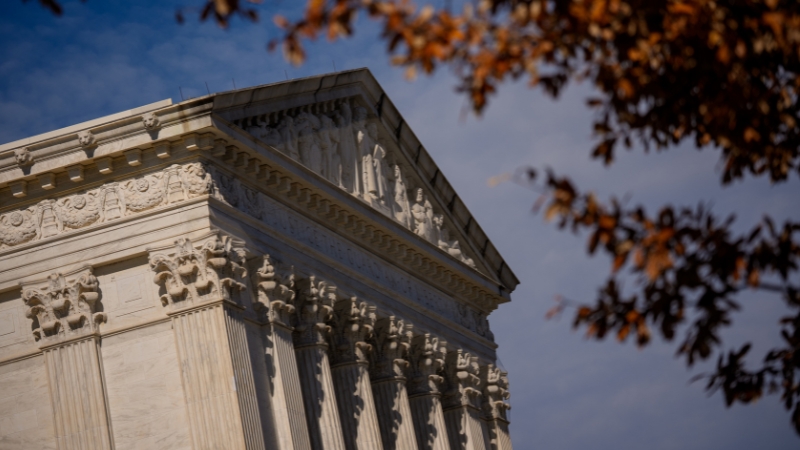
In a 6-3 ruling yesterday, with Justices Kavanaugh, Thomas and Alito dissenting, the Supreme Court ruled that all of President Trump’s tariffs enacted under the auspices of the International Emergency Economic Powers Act (IEEPA) are illegal.
A scorching dissent from Justice Kavanaugh laid bare some of the consequences of the decision, as well as its complete incoherence.
Kavanaugh warned of “serious practical consequences in the near term.”
“One issue will be refunds. Refunds of billions of dollars would have significant consequences for the U.S. Treasury. The Court says nothing today about whether, and if so how, the Government should go about returning the billions of dollars that it has collected from importers. But that process is likely to be a ‘mess,’ as was acknowledged at oral argument,” he wrote.
The US could be required to pay back billions of dollars to importers, even though they have passed on the costs to consumers.
“A second issue is the decision’s effect on the current trade deals. Because IEEPA tariffs have helped facilitate trade deals worth trillions of dollars—including with foreign nations from China to the United Kingdom to Japan, the Court’s decision could generate uncertainty regarding various trade agreements. That process, too, could be difficult.”
Kavanaugh is in no doubt: Congress has granted the President the right to enact tariffs under the IEEPA.
“Does Congress’s explicit grant of authority in IEEPA for the President to ‘regulate… importation’ of foreign goods in declared national emergencies authorize the President to impose tariffs? The answer is a clear yes.”
There are strong precedents for Trump’s policy too.
“For both the Nixon tariffs and the Ford tariffs upheld by this Court in Algonquin, the relevant statutory provisions did not specifically refer to ‘tariffs’ or ‘duties,’ but instead more broadly authorized the President to ‘regulate… importation’ or to ‘adjust the imports.’ Therefore, when IEEPA was enacted in 1977 in the wake of the Nixon and Ford tariffs and the Algonquin decision, Congress and the public plainly would have understood that the power to ‘regulate… importation’ included tariffs.”
“If Congress wanted to exclude tariffs from IEEPA,” Kavanaugh continued, “it surely would not have enacted the same broad ‘regulate… importation’ language that had just been used to justify major American tariffs on foreign imports.”
What’s more, and what’s worse, the position of the plaintiffs and the Supreme Court doesn’t even make sense. It’s self-contradictory. Both parties recognise the IEEPA can be used to impose trade quotas and even embargoes—complete bans.
So why not tariffs?
“As they interpret the statute, the President could, for example, block all imports from China but cannot order even a $1 tariff on goods imported from China,” Kavanaugh wrote.
“That approach does not make much sense. Properly read, IEEPA does not draw such an odd distinction between quotas and embargoes on the one hand and tariffs on the other. Rather, it empowers the President to regulate imports during national emergencies with the tools Presidents have traditionally and commonly used, including quotas, embargoes, and tariffs.”
President Trump called the ruling “deeply disappointing,” and said he’s “absolutely ashamed” of some of the justices “for not having the courage to do what’s right for our country,” presumably the “conservatives” Gorsuch and Barrett. He’s also said there’s evidence of “foreign influence” over the decision; although what that is, and where it came from, is yet to be seen. Canada is one possible suspect.
Soon after the decision, Trump used the Trade Act of 1974 to issue 10% tariffs across the board, but this is just a stopgap, designed to last for 150 days before a vote in Congress is required. The administration is looking at other means for issuing tariffs with greater sticking power. Justice Kavanaugh provided some helpful notes in his dissent. As well as the Trade Act, Section 338 of the Tariff Act of 1930 could also be used.
Despite the setback, the administration seems confident. Treasury Secretary Scott Bessent has said he believes revenue projections will not be affected by having to issue tariffs under new authority.
That may be so, but the wider significance of Friday’s ruling should not be missed. This is another important step towards the unraveling of American democracy, even if Tocqueville didn’t predict it happening in quite this manner.