 Image Credit: @netanyahu / X screenshot
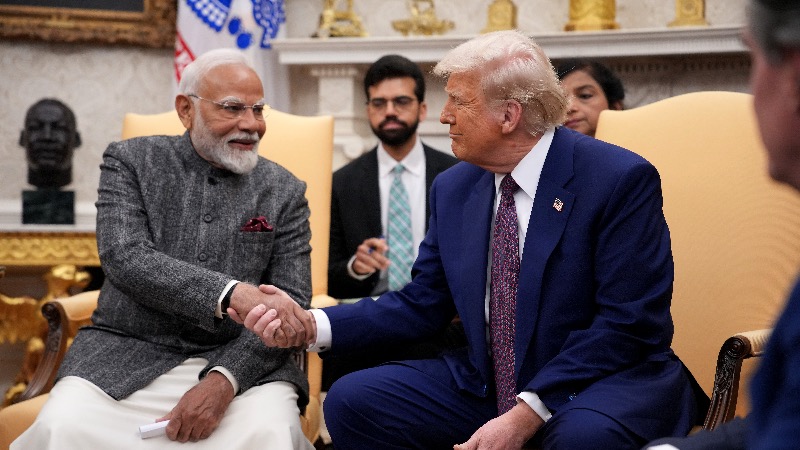
On Sunday the Israeli government imposed sweeping changes to land registration and civil control over the West Bank resulting in a de facto annexation. President Donald Trump had voiced his opposition to such a move while meeting with Israeli Prime Minister Benjamin Netanyahu in December. On Tuesday Netanyahu announced he is traveling to the U.S. where he will meet with Trump to discuss the Iran situation, the White House’s ongoing Gaza peace plan and other issues.
While Trump and Netanyahu’s upcoming Wednesday meeting is mainly focused on Iran’s nuclear program negotiations, the West Bank developments may also receive some attention due to the two leader’s disagreement over the issue.
U.S. and Iranian officials held indirect nuclear talks in Muscat, Oman on Friday. Tehran insisted on its “right to enrich uranium” but its missile capabilities were not discussed at that meeting. The talks took place directly after the Pentagon conducted live-fire drills off Iran’s coast as tensions escalate.
Washington and Tehran continue their negotiations on Tuesday, with the Islamic Dictator saying he hopes to reach a “balanced and just” agreement.
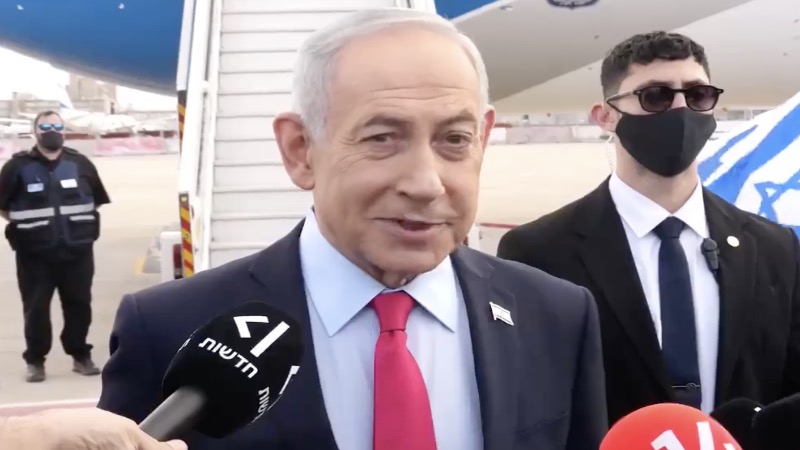
Netanyahu spoke to the press as he departed the Jewish State:
I’m heading out now to the United States for my seventh trip, to meet with President Trump since he was elected for his second term. This, of course, does not include his unforgettable visit to Israel and his speech in the Knesset.
I believe these things reflect the unique closeness in the extraordinary relationship we have with the United States, and personally between me and the President, and between the State of Israel and the United States – something unprecedented in our history.
On this trip we will discuss a series of issues: Gaza, the region, but of course first and foremost the negotiations with Iran.
I will present to the President our positions regarding the principles of the negotiations, the important principles, and in my view they are important not only for Israel – but for everyone in the world who wants peace and security in the Middle East.
The Middle East Eye detailed the specifics of Israel’s policy shift in regard to the West Bank:
Under the new Israeli measures, the military would be able to enforce regulations on so-called unlicensed buildings in Areas A and B, citing heritage and archaeological sites, allowing for the confiscation of Palestinian land and demolition of structures.
The changes would also lift secrecy on West Bank land registries, enabling settlers to identify Palestinian landowners and purchase land directly.
Exposing ownership records could make it easier for settlers to forge claims over Palestinian land, a tactic widely documented and likely to accelerate land seizures across the occupied territory.
The measures also ease the sale of Palestinian land to Israelis and overturn a Jordanian-era law prohibiting transfers to non-Palestinians.
Planning, licensing, and construction powers in Hebron would be transferred from the Palestinian municipality to the Israeli army, expanding control over building permits, development, resources, and security. An independent local authority will also be established for the Israeli settlement in Hebron.
When Netanyahu met with Trump on December 29 to discuss the ongoing Gaza peace plan, the President told the press that disagreement remained regarding the West Bank’s future, with Trump being against an Israeli annexation of the region.
“[We] don’t agree on the West Bank 100%, but we’ll come to a conclusion on the West Bank. .. He will do the right thing,” Trump said.
According to Israeli Finance Minister Bezalel Smotrich and Israeli Defense Minister Israel Katz, these policy changes to the West Bank would “dramatically” alter its relationship with Israel, paving the way for expanded settlements and land seizures.
Middle East Eye detailed the joint statement from the Israeli officials, who said the measures would remove legal barriers on Israeli settlers and also accelerate the settlement’s development:
Katz said the aim was to give settlers equal “legal and civil rights”, while Smotrich said the move would “normalise life in the West Bank” and vowed to “continue to kill the idea of a Palestinian state.”
Palestinian President Mahmoud Abbas said the policy was designed to deepen annexation of the West Bank and violated agreements signed with Israel, including the Oslo Accords, according to the Wafa news agency.
On Tuesday Israeli Energy Minister Eli Cohen told Israel’s Army Radio that Israeli is implementing “de facto sovereignty,” and that “[the steps] actually establish a fact on the ground that there will not be a Palestinian state.”
“Palestinians, Arab countries and human rights groups have called the moves announced Sunday an annexation of the territory, home to roughly 3.4 million Palestinians who seek it for a future state,” an Arab news outlet reported Tuesday.
Israel has already been involved in land grabs of the West Bank, claiming almost 2,000 acres in 2024, for example.