 Image Credit: Tim Graham / Contributor / Getty Images
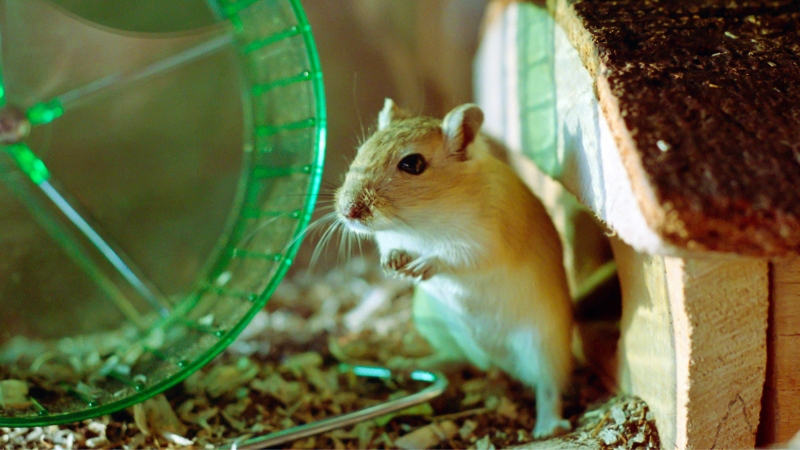
The Mongolian gerbil, Meriones unguiculatus, is a small rodent, typically around 8-10 inches from nose to tail. They inhabit the vast grasslands and deserts of Mongolia, the Russian Federation and northern China. Believe it or not, these cute little animals can tell us quite a lot about testosterone.
The pop-science view of testosterone is, of course, that testosterone promotes aggression. If a man has more testosterone, he’s going to be more of a handful than a man who has less: more likely to engage in retrograde behaviours like fighting and raping and killing and so on. The implication, then, is that if we want to live in a safer, more peaceful society, it would be better if there were less testosterone to go around.
That’s why, a little while back, notorious shitlib director James Cameron said he was glad finally to have rid his body of the “toxin” testosterone, which presumably had led him to make all those great films in the 1980s like The Terminator, Aliens and The Abyss.
Testosterone levels generally decline as a man ages—1% year on year from the age of 30, it’s generally agreed—but there are also things a man can do if he really wants to speed up that process, like becoming a vegan. James Cameron is a vegan.
Pop-science isn’t wrong, at least not totally—testosterone is involved in aggression—but things are just a little bit more complicated.
This is where the gerbils come in.
In my new book, The Last Men: Liberalism and the Death of Masculinity, I discuss a recent study that suggests testosterone has context-dependent effects, and can promote loving effects too.
Male gerbils were allowed to bond with female gerbils and get them pregnant. The male gerbils were then given a shot of testosterone. The researchers believed this would be make the male gerbils less interested in their partners, but in fact the complete opposite happened. Instead of going off an looking for other females to mate with, the males became “super partners,” spending large amounts of time cuddling with their mates and attending to their needs.
This was part one of the experiment. In part two, the males were separated from their mates and placed with unknown males. Under normal circumstances, this would lead to an immediate showdown, but because the males had been turned into “super partners,” it didn’t.
This changed, however, when they were given another shot of testosterone. Now they either chased the unknown male or ran away and hid.
One of the researchers explains: “It was like they suddenly woke up and realized they weren’t supposed to be friendly in that context.”
What this points to, as I suggested, is that testosterone has context-specific effects. In one context, it promotes love and affection; in another, aggression. This is important, among other things, because it makes it much harder to argue that testosterone decline is something we should welcome.
Yes, I hear you say, but gerbils aren’t humans, are they?
Scientists generally use animals for more complex experiments involving testosterone, in large part because you can do things to animals you can’t to humans—at least, if you want to pass a university ethics board.
Most human studies of testosterone involve the administration of testosterone gel to subjects who are then asked to play a game or answer questions that gauge attitudes and beliefs. Such studies reveal, for example, that men given a dose of testosterone are lore accepting of inequality and hierarchy. This is an important revelation, with potentially important political consequences—leftism, remember, is at base a project to end inequality and flatten hierarchy—but such studies are, nevertheless, quite simplistic.
More complicated and inventive human studies of testosterone are now being carried out. For example, researchers followed a group of Bolivian Indians as they went out hunting in the jungle and took samples before, during and after the hunt so they could track changing hormone levels. They found that testosterone rose during the hunt itself, where individual distinction and skill usually determine whether a kill takes place, but this increase also tracked with levels of oxytocin, the so-called “love hormone” that’s usually associated with bonding between people. What this suggests is that oxytocin might help to reinforce behaviours that demonstrate individual prowess but also help the group.
What’s clear, at least, is that we’re moving further and further away from the view that testosterone is an “anti-social” hormone, or even the “anti-social” hormone.
If you care about masculinity and think it matters and needs to be preserved, that can only be a good thing. Next time you see a gerbil, give him something nice. They like dried fruit, apparently, and sunflower seeds.
The Last Men: Liberalism and the Death of Masculinity is out now in hardcover, Kindle and audiobook formats from Amazon and all good bookstores. Subscribe to Raw Egg Nationalist’s Substack to receive regular essays on politics, culture, and health and fitness.