 Image Credit: Anadolu / Contributor / Getty
On Tuesday it was reported that British National Security Adviser Jonathan Powell had attended the final round of negotiations between the U.S. and Iran, and believed that the offer proposed by Iran “was significant enough to prevent a rush to war.”
Indeed, as Infowars reported at the time, the talks were going well enough to warrant a continuation of negotiations in Vienna, Austria the following week. Those talks never came, as Israel and the U.S. attacked Iran just days later. With that said, President Donald Trump did tell Iran that he was mulling military action.
On February 19 President Donald Trump set a 10-day deadline for Iran to make a deal, or face U.S. military operations against it.
“So now we may have to take it a step further, or we may not,” Trump said on February 19 while speaking at the first meeting of his new Board of Peace working group.
It was reported Tuesday that the British official who was at the meeting between Washington and Iran believed the talks were not just constructive, but resulted in a surprising proposal:
Powell thought progress had been made in Geneva in late February and that the deal proposed by Iran was “surprising”, according to sources.
Two days after the talks ended, and after a date had been agreed for a further round of technical talks in Vienna, the U.S. and Israel launched the attack on Iran.
Powell’s presence at the talks, and his close knowledge of how they were progressing, was confirmed by three sources.
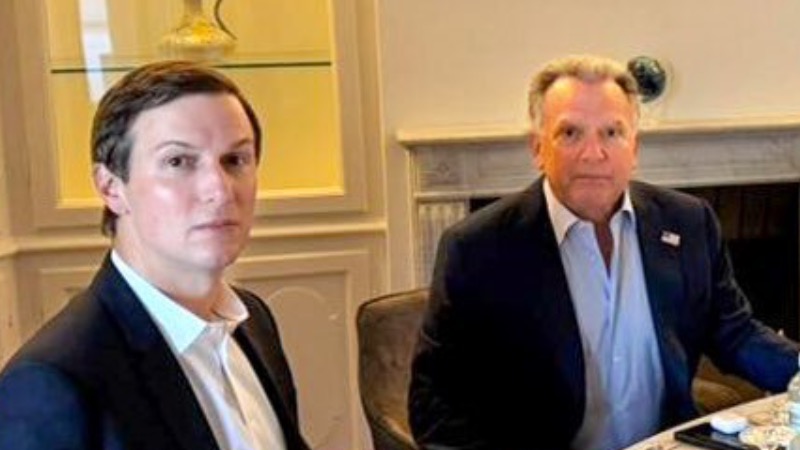
One source said he was in the building at Oman’s ambassadorial residence in Cologny, Geneva, acting as an adviser, reflecting widespread concern about the U.S. expertise on the talks represented by Donald Trump’s son-in-law Jared Kushner and Steve Witkoff, Trump’s special envoy on several issues.
The reporting also alluded to the fact that the U.S. team appeared unprepared to accept an Iranian proposal due to the lack of technical advisors, though they did have an international atomic energy official at the meeting:
Kushner and Witkoff had invited Rafael Grossi, the director general of the International Atomic Energy Agency (IAEA), to the Geneva talks, to provide technical expertise, though Kushner would later claim that he and Witkoff had “a pretty deep understanding of the issues that matter in this”.
Nuclear experts would later say that Witkoff’s pronouncements on the Iran nuclear programme were riddled with basic errors.
Powell has long experience as a mediator, and one source said Powell brought an expert from the UK Cabinet Office with him. One western diplomat said: “Jonathan thought there was a deal to be done, but Iran were not quite there yet, especially on the issue of UN inspections of its nuclear sites.”
A former official who was briefed on the Geneva talks by some of the participants said: “Witkoff and Kushner did not bring a U.S. technical team with them. They used Grossi as their technical expert, but that is not his job. So Jonathan Powell took his own team.
“The UK team were surprised by what the Iranians put on the table,” the former official added.
“It was not a complete deal, but it was progress and was unlikely to be the Iranians’ final offer. The British team expected the next round of negotiations to go ahead on the basis of the progress in Geneva.”
Interestingly, Infowars reported on a think tank analysis document from 2009 which outlined how the U.S. or Israel could launch a regime change war on Iran under the guise of negotiations – using the cover of failed diplomacy to curry public favor for an otherwise unpopular conflict. Tuesday’s report adds to the possibility that purposefully-failed negotiations were used as cover to go to war.
The analysis white paper “Which Path To Persia? Options for a New American Strategy toward Iran” published by The Saban Center for Middle East Policy at The Brookings Institute outlined a war plan which would begin with peaceful talks that are intended to fail, the failure of which could be pointed to as the reason for an offensive military operation.
“The best way to minimize international opprobrium and maximize support (however, grudging or covert) is to strike only when there is a widespread conviction that the Iranians were given but then rejected a superb offer—one so good that only a regime determined to acquire nuclear weapons and acquire them for the wrong reasons would turn it down,” the document said on page 39. “Under those circumstances, the United States (or Israel) could portray its operations as taken in sorrow, not anger, and at least some in the international community would conclude that the Iranians ‘brought it on themselves’ by refusing a very good deal.”
Recent negotiations running cover for a pre-planned attack appear likely, as Reuters reported on February 28 that “An Israeli defense official said the operation had been planned for months in coordination with Washington, and that the launch date was decided weeks ago.”
The Cradle gave a rundown on events leading up to the strike:
Amid the negotiations, Trump sent an “armada” of U.S. naval ships and warplanes to the region, threatening to launch an attack if officials in Tehran refused to make a deal.
After the latest round of talks on Thursday, a senior U.S. official told Axios the talks were “positive.”
Omani Foreign Minister Badr Albusaidi, who mediated the talks, said the talks had shown “significant progress.”
Iranian Foreign Minister Abbas Araghchi also expressed optimism, saying both sides had shown a “clear seriousness” about getting a deal.
However, the U.S. and Israel launched large-scale attacks against Iranian targets early Saturday, suggesting the negotiations had never been serious.
AF Post reported that Israel had already decided to strike Iran, and that the U.S. decided to join in on the attack.
Infowars recently reported how Washington’s allies and trading partners have refused to aid Washington and Tel-Aviv in their war efforts. London’s reasoning for refusal appears to stem from their assessment of the negotiation process:
The UK saw no compelling evidence of an imminent threat of an Iranian missile attack on Europe, or of Iran securing a nuclear weapon. This is the first time it has become clear that Britain was so closely involved in the talks, and so had good reason to decide whether diplomatic options had been exhausted and a U.S. attack was necessary.
Instead the UK regarded the attack as unlawful and premature since Powell believed the path remained open to a negotiated solution to the long-running issue of how Iran could reassure the U.S. that it was not seeking a nuclear weapon.
Trump previously appeared to remain optimistic of reaching a nuclear deal with Iran throughout 2025.
Trump was unhappy with the 2015 Iran nuclear deal and withdrew from it during his first term in office.
Notably, this 2015 ‘Iran nuclear deal’ involved President Barack Obama shipping $400 million in cash on pallets to Tehran in exchange for the promise they will refrain from developing nuclear weapons.